Alix Amo (AA): Can you please update me on some basic information, including your date of graduation from the EV program, current employer and position, social media handles, and preferred contact information?
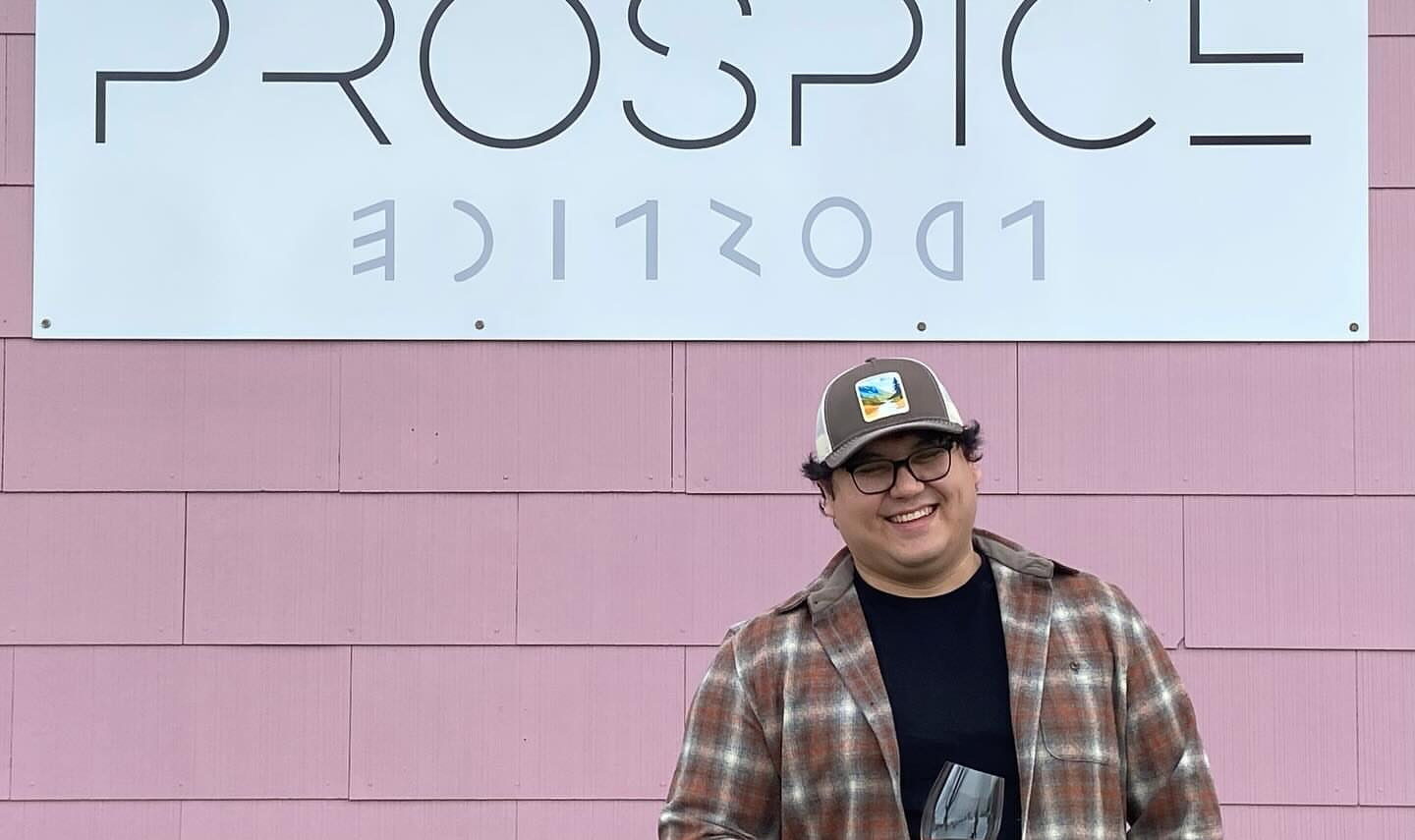
Gene Hoffman (GH): I graduated the EV program in 2024 and am currently the cellar master at Prospice. I’m not big on social media but my email is gene-hoffman@hotmail.com, @genespicks on Instagram.
AA: How did you get into wine?
GH: I got my start in wine here in Walla Walla while I was working on my undergraduate degree at Whitman during 2013 through 2017. During that time I had a number of friends who worked in tasting rooms. It was a very common thing. And though I wasn’t working in the industry yet, I got to learn about wine through them, I would hang out in tasting rooms, and got to enjoy wines that my friends brought home. I got to experience and enjoy wine at that level, but at the time my appreciation and understanding of wine was pretty low.
After that I worked before and during the pandemic at Trader Joe’s in the Seattle area as the wine steward. It was amazing, I was in there every day talking to customers about wine, opening up bottles for tasting in the store, and spending my down time at work reading books and studying wine. Over the course of my four years there I got to try about 500 to 600 wines and I got to tweak what was on the shelves as the category manager. I greatly enjoyed my time as wine steward, but finally after four years I decided to quit and work my first harvest internship at Novelty Hill-Januik. It was full grunt work, a true 80-hour-a-week job. They had an in-house kitchen and fed me breakfast, lunch, and dinner, so I would be there for 12 hours a day, seven days a week. It was an intense harvest, but so fun.
AA: How many people were on the crew, and how many tons did you process?
GH: We had a crew of 6 full-time staff and two harvest interns. In 2021 we probably came close to 700 tons! After harvest I went on to work at the tasting room at Novelty Hill for the better part of a year, as well as the tasting room at Long Shadows, before starting the EV program in Fall of ‘22.
AA: What did you study at Whitman?
GH: I studied biology, specializing in microbiology and immunology – I didn’t know that wine would be my career, but it just so happened that I picked a direction and area of study that was very relevant to wine! I get to use all of my biology background currently as cellar master at Prospice, and was the lab tech for the two years I was at Long Shadows.
AA: As the Woodinville wine steward at Trader Joe’s, how did you mitigate choice overload for consumers?
GH: Certainly, when you walk into a store like Trader Joe’s or any other large retail store, as a buyer it can be really impossible to choose one bottle over another. So there were strategies we used to highlight bottles. For us, it wasn’t so much about just making a sale, it was about being sure that customers left with something that was what they wanted and would really enjoy. We want people to be happy with their purchase. That way we built up hundreds of repeat customers. So we created “Gene’s Picks”, cultivating trust and rapport with the customers. I picked wines that were exemplary of their style and the best for their value. We would have five or six Gene’s Picks at a time that would change around, and we would sell out of those wines – we couldn’t order enough Gene’s Picks!
The other tactic I used happened whenever I got to talk to a customer directly. I would ask them about their background with wine, what kind of thing they were looking for, and once I had an idea of what they might enjoy, I would pick my top two choices, present these as options, explain the differences between the two, and I would say that about 75% of the time, these customers would just end up buying both bottles that I had presented! By picking out two options that were in their desired category and price range, the guest’s curiosity in wine and their trust in me would lead them to buying both recommendations. People were happy, they got to experience wine and learn more about it, and became repeat customers.
AA: Is there someone in the EV world you admire, including fellow EV alum?
GH: My favorite person to talk about right now is Drew Pauk at Moonbase. I met Drew along with other 2019 EV alums at Yellowhawk. Through that interaction, Drew offered me a part-time job while I was going to CC, so I worked for him for about six months. I love the guy and respect him so much! He’s got such an honest, collaborative willingness to teach you and work with the community. He will spend hours of his day, despite having a million other things going on, and having a family, and he will talk and answer questions for hours. He had such a willingness to show me and teach me what he knows, and I think he’s amazing. I think his wines are awesome, and he’s a super nice guy.
AA: What’s special to you about working in the wine industry?
GH: You can find the chance to connect with people, build the friendliness, and help each other out when things are up or down. There’s a lot of things that are special – the atmosphere and environment are a huge part of it. I also really enjoy the conversational nature of wine. I get to interact with people all over the industry, and we have this common language that we can talk with and share. We are all part of one industry together, and I just love it, I feel comfortable here. I feel a sense of family and community.
AA: What’s your favorite part of your job?
GH: My job is very much a jack-of-all-trades. I like having the responsibility of managing all the day-to-day winemaking, and having so many chances to do vineyard work and laboratory work as well. On top of that, we have this amazing sound system in our cellar. I love blasting my music, often while doing punchdowns or whatever else, and it barely feels like work. It’s perfect.
AA: What are some of the challenges you’ve faced in the industry?
GH: I feel like I’ve been pretty fortunate, been able to work seamlessly from job to job and been able to work with amazing people, so I’d say I haven’t faced too many obstacles. Of course every vintage is faced with its own challenges, for example, climatic impact. And the thing that helps the most when you’re dealing with issues you can’t predict is being able to think on the fly. I think the mark of a good winemaker is quick problem solving. I feel like I’m on my way there. I would say understanding and harnessing the non-scientific side of wine is still a challenge to me. I think I have the technical component down, but I’m still seeking the sensory and creative components. It’s harder for me to be confident with decisions that use that side of my brain.
AA: What do you think differentiates and excites you about Washington wine?
GH: I’ve grown up in Washington, and been here most of my life. I come from Woodinville near Seattle, did my undergrad in Walla Walla, and I think that Washington has the ability to grow anything – we have heat units to ripen anything, there are cooler spots and higher elevation areas, there are shady spots, so if you want to grow cool climate varietals you can do that as well, and with irrigation we can grow even where there isn’t water. So because we have the ability to grow any varietal, minus any climatic encounters, I think the flexibility of Washington is without comparison.
You think about Washington, and you think Cab, Syrah, Merlot, but there isn’t any one varietal that we are known for. I feel like Washington is everything. And there is probably so much more that has yet to be explored in Washington, because we can pretty much grow any varietal and even go with our own style, and it can be really amazing. You can work with or taste almost anything, and it’s all probably going to be very high quality. There are no limitations of what can be achieved.
AA: How do you foresee climate change or social issues affecting the local industry in the next few years?
GH: I think climate change has affected us already and will continue to affect us a lot. Our most recent encounter was the frost last year. You’re going to get temperature extremes, you’re going to get wildfires, and in terms of social issues I’ve heard of Washington wines being pulled in Canada in response to tariffs. So that is also something that is going to impact the wine industry. There’s a lot of uncertainty and I’d say generally downward facing trends for both climate change and social issues. I do hope we will see an upturn in the future.
There is obviously the changing nature of wine in response to the younger generation, what their palate wants, and what wine will be in the future. I don’t know if I see anybody that has figured out what wine will look like five to ten years from now. So I think it’s important for all of us to be forward looking and try not to be too rigid about a certain style or certain goal. If you do not change with the times, you will be left behind. Flexibility is key. It’s important, it’s huge, it can’t be ignored. Something I personally am really passionate about is understanding the future of wine and finding what is going to be that cutting edge and riding that wave.
AA: What are some up-and-coming trends in wine that you’re following?
GH: I think sparkling wine is a popular category for this question, it’s certainly worth putting on our radar. Lower alcohol wines are also gaining popularity. That seems to be a pretty consistent style for certain demographics. Even non-alcoholic wine could be something that we see start to trend. I’m curious about it all.
AA: What advice can you share with future EV graduates?
GH: I would say, stay hungry for information, and write down everything that you can. Sometimes we get small nuggets of important information and if we don’t write them down we will forget! There’s so much information out there, and always more people to learn from. So keep asking questions and continue to devour knowledge wherever you can. Put yourself out there, go to industry events and talk to people!
Join the Conversation